
Why AI ROI Depends on Orchestration: Briick at The Customer Show 2026
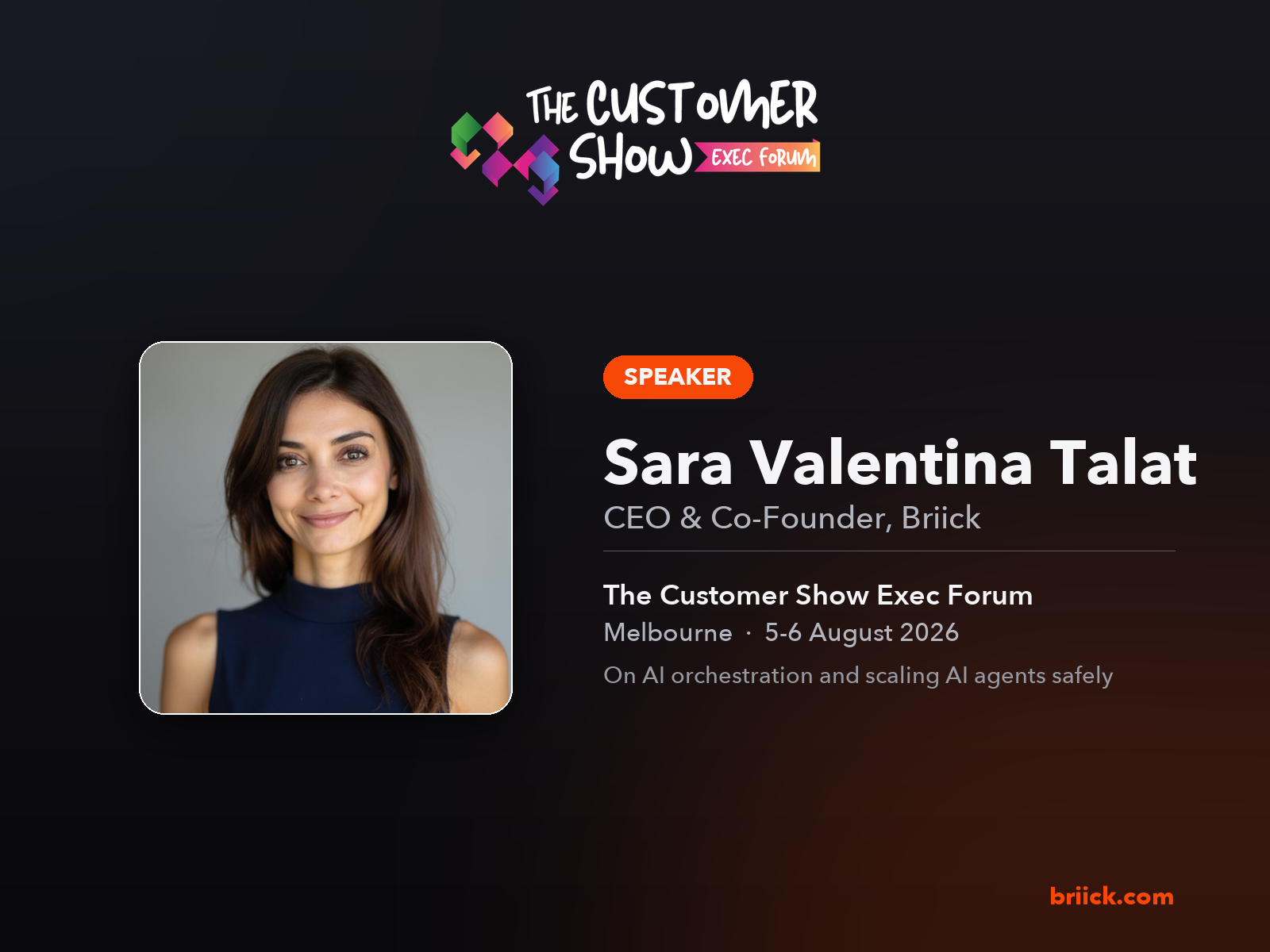
Briick's Co-Founder and CEO, Sara Talat, is speaking at The Customer Show Exec Forum 2026 in Melbourne. Across two sessions she makes one argument service businesses need to hear in 2026: the return on AI does not come from buying more tools, it comes from connecting them and running them safely. The first session, a table discussion, covers the orchestration advantage, why AI ROI depends on connecting the dots rather than deploying more AI tools. The second, a panel, covers scaling AI agents safely, reducing cost without pushing complaints up. This post walks through both, and where @Briicky, Briick's AI Chief of Staff, fits.
This piece covers what the orchestration advantage means and why it drives AI ROI, how to scale AI agents safely without raising complaints, where the AI Chief of Staff sits in that picture, and the full details on when and where to catch Sara at the forum.
Both themes answer a hard year for AI spend. MIT's Project NANDA studied 300 enterprise deployments for its 2025 report, The GenAI Divide: State of AI in Business, and found 95 percent of enterprise generative AI pilots delivered no measurable return on the bottom line. Gartner expects more than 40 percent of agentic AI projects to be cancelled by the end of 2027, citing escalating cost, unclear business value, and weak controls. The capability is real. The way AI gets bought, connected, and governed is where the return leaks out, and that is exactly what both of Sara's sessions are about.
The orchestration advantage: why AI ROI depends on connecting the dots
Most AI you can buy is a point solution. A chatbot for the website, a scheduler for the calendar, a receipt reader for the accounts. Each does one task and talks to nothing else, so the time saving stays on the slide and never reaches the bank account. The return does not live in any single tool. It lives in the workflow completing, a lead qualified, a quote sent, a follow up made, a job booked and invoiced, without a person carrying the context from one tool to the next by hand.
Orchestration is the layer that connects those dots: one system that sees across your tools, holds the shared context, and drives the whole workflow. That is the case Sara takes to the table discussion, and it is the full argument in why your AI is not saving time and how to get real ROI.
Scaling AI agents safely: reducing cost without increasing complaints
Putting an AI agent in front of customers has two failure modes, and both cost money. Staff every AI conversation with a human reviewer and you have added cost instead of removing it. Let the agent run unchecked and you save on wages while paying it back in wrong answers and lost customers. A confident wrong answer is a real liability: in February 2024 a Canadian tribunal held Air Canada responsible for wrong information its own chatbot gave a customer.
Scaling safely means splitting the work by risk. Let the agent handle the high volume, low risk conversations on its own, and route anything sensitive or ambiguous to a person, with the agent preparing the case so the person is faster. Cost falls because the volume is absorbed. Complaints stay flat because the moments that create them still reach a human. That is the panel Sara joins, and the six controls behind it are in whether you can trust an AI agent with your customers.
Where @Briicky fits
@Briicky is Briick's AI Chief of Staff, and it is the orchestration argument made real. You tell it what you want in plain language, by voice or text, and it acts across your tools: build the estimate, raise the invoice, prepare the BAS, pull the report. Your business data lives in your own AI database, a vector store built for your business, so every answer is drawn from everything the business knows. It runs the other AI agents, a voice AI agent taking calls, an SMS AI agent following up, and keeps them pointed at one goal, escalating to a person the moment a conversation turns sensitive. One operator connects the dots and holds the guardrails, which is the through line across both of Sara's sessions. For the full picture, read what an AI Chief of Staff actually is and the difference between a chatbot and orchestration.
Event details
The Customer Show Exec Forum 2026 runs on 5 and 6 August 2026 at The Atrium, Flemington Racecourse, Melbourne, hosted by IQPC. It brings together customer experience, insights, and contact centre leaders from across Australia. Sara's two sessions fall on the second day, Thursday 6 August: the table discussion on the orchestration advantage, and the panel on scaling AI agents safely. You can see Sara listed among the speakers on The Customer Show Exec Forum event page.
Frequently asked questions
Where is Briick speaking in 2026?
Briick's Co-Founder and CEO, Sara Talat, is speaking at The Customer Show Exec Forum 2026 in Melbourne, held on 5 and 6 August 2026 at The Atrium, Flemington Racecourse, and hosted by IQPC. She runs a table discussion on AI orchestration and joins a panel on scaling AI agents safely.
What is the orchestration advantage in AI?
The orchestration advantage is that AI return comes from connecting your tools, not from buying more of them. A single tool automates one task. Orchestration puts one layer over the whole stack that holds the shared context and drives the entire workflow to completion, which is where the time and money actually show up.
How do you scale AI agents safely?
Split the work by risk. Let an AI agent handle high volume, low risk conversations on its own, and route anything sensitive or ambiguous to a person, with the agent preparing the case. Add a narrow scope, answers grounded in your own data, a confidence threshold, human sign off on sensitive actions, a clean escalation path, and logged conversations. That reduces cost while keeping complaints flat.
What is an AI Chief of Staff?
An AI Chief of Staff is a single AI system that runs your business operations from one conversation. You tell it what you want in plain language, by voice or text, and it controls your tools, your data, and your other AI agents to get the work done. @Briicky is Briick's AI Chief of Staff.
Who is Sara Talat?
Sara Talat is the Co-Founder and CEO of Briick, an Australian company building the AI Chief of Staff for service businesses. She is speaking at The Customer Show Exec Forum 2026 in Melbourne on AI orchestration and on scaling AI agents safely.
See the AI Chief of Staff in action
If you want to see how one operator connects your tools and runs your AI agents safely, book a demo with Briick. If you want the numbers first, see how Briick's pricing works.



TLDR Summary
- Sara Talat, Briick's Co-Founder and CEO, is speaking at The Customer Show Exec Forum 2026 in Melbourne, 5 to 6 August 2026 at The Atrium, Flemington Racecourse, hosted by IQPC.
- She runs two sessions: a table discussion on the orchestration advantage (why AI ROI depends on connecting the dots), and a panel on scaling AI agents safely (reducing cost without increasing complaints).
- The orchestration argument: AI return comes from connecting your tools into one workflow, not from buying more point tools that each do one task.
- Scaling safely means splitting work by risk: an AI agent handles high volume routine conversations, a person handles the sensitive ones, so cost falls and complaints stay flat.
- MIT's 2025 research found 95 percent of enterprise generative AI pilots delivered no measurable return; Gartner expects over 40 percent of agentic AI projects cancelled by end 2027.
- @Briicky, Briick's AI Chief of Staff, is the through line: one operator that connects the dots and holds the guardrails.